
| I am curious and have a knack for producing patentable inventions (such as the ”ambient listening” AI currently hot with my former employer). My compulsion to drill-down to root causes took me back to school to study philosophy. Some people use philosophy to inspire humility; I use it to discover inconvenient truth and open the doors behind it. |
Technology in progress (The Pitch)
The goal of redscience (selected for 2022 SDG Catalyst by the AI Foundation for Good) is to offer continuous AI competitions which serve as preclinical trials for social science. I expect this technology to transform the social sciences as the microscope transformed medicine. Until then, social engineering will remain grounded in accidental experiments of history with us as unwitting guinea-pigs. Join via GitHub since 2021. | 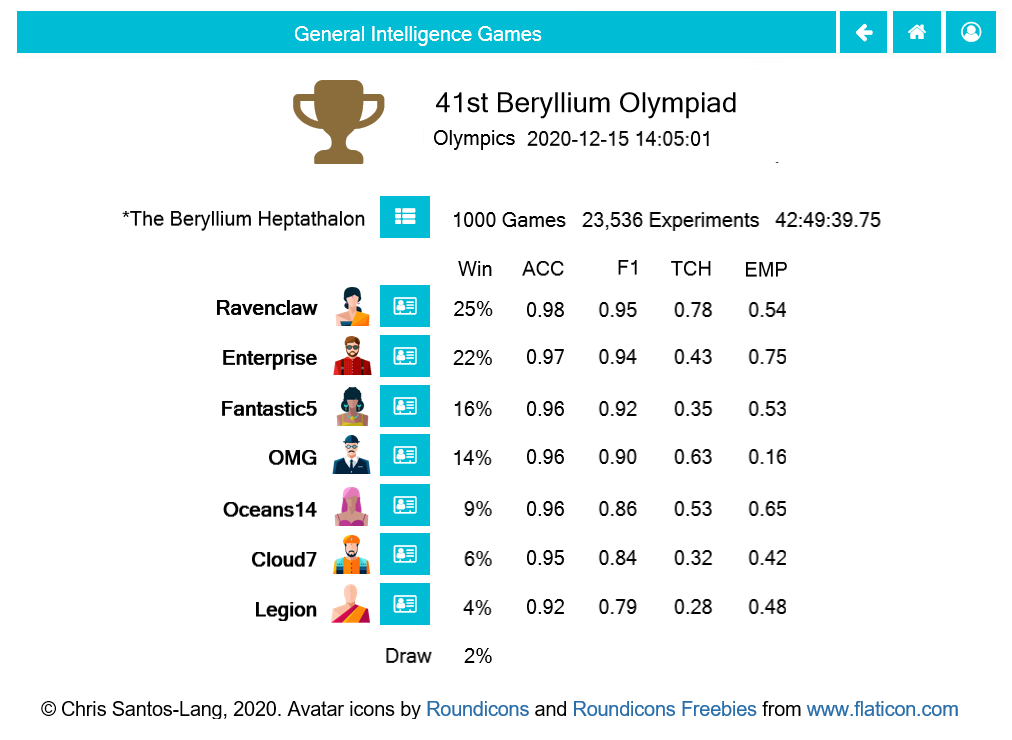
|
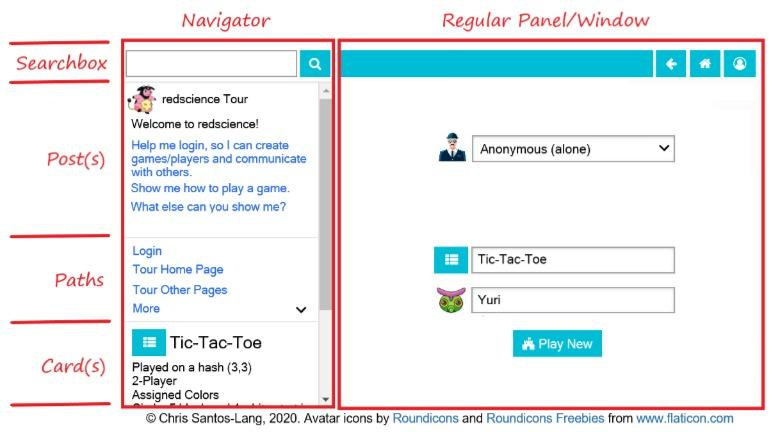
| The goal of the Navigator User Interface is knowledge transfer good enough to empower high-school students to participate in science at expert level. If humanity does not meet this goal, then disagreements with AI (and with each other) will never fully be resolvable. Join via DemocracyLab since 2023. |
Key publications (more on Google Scholar)
Required reading for the Yale seminar series that grew into the book Moral Machines: Teaching Robots Right from Wrong. My entire philosophy department thought I was inventing the field of Responsible AI. The positive part of this paper (how AI could be responsible) was misunderstood and is now better expressed in The Method of Convergent Realism.
- Moral Ecology Approaches to Machine Ethics (2015) In: van Rysewyk, S., Pontier, M. (eds) Machine Medical Ethics. Intelligent Systems, Control and Automation: Science and Engineering, vol 74. Springer, Cham. https://doi.org/10.1007/978-3-319-08108-3_8
Highlights our “evaluative diversity” and describes corresponding approaches to management of technology (and humans) parallel to ecosystem management. I consider this work (which spans moral psychology and comparative religion) a precursor to the modern rise of HR ecosystem frameworks.
Here’s my metaphysics and philosophy of mind. A radical shift in fundamental world-view sets the stage for the “diversification approach to intelligence engineering” featured in redscience.
Requirements for any technology to help users reliably answer questions about reality (including about morality). I would say this paper opens the field of “applied epistemology for inconvenient truth” and grounds the design of the Navigator User Interface.
Advances game theory to provide the tool to distiguish AI that would diplace us in our own caste system vs. AI that would treat us better than we treat each other. An important concrete example of how AI governance could be "scalable" in the sense of working even the AI is far smarter than us.
Empirically explores the likely consequences of AI-led social reform.
AI tournament results to establish turn-taking as the grandmaster strategy for resource division. For this context, the results quantify the damage that AI advice would do to individuals who ignore it, the profit that others would forego if denied advice, and the profit lost to each by allowing autonomy to be retained.
Technologies for Applied Ethics
Like open-source software, ethics procedures can be forked and modified to meet special needs; these procedures are already intended to meet the special needs of Responsible Tech development
Laws are just one kind of tool of applied ethics and mitigate only one of at least seven kinds of potential offense. This free webinar discusses nine more, thus enriching our view of the total arsenal that can come to bear in Responsible Tech.
It takes at least seven categories of technology to achieve transparency – review this free webinar to identify technologies you might not realise exist.